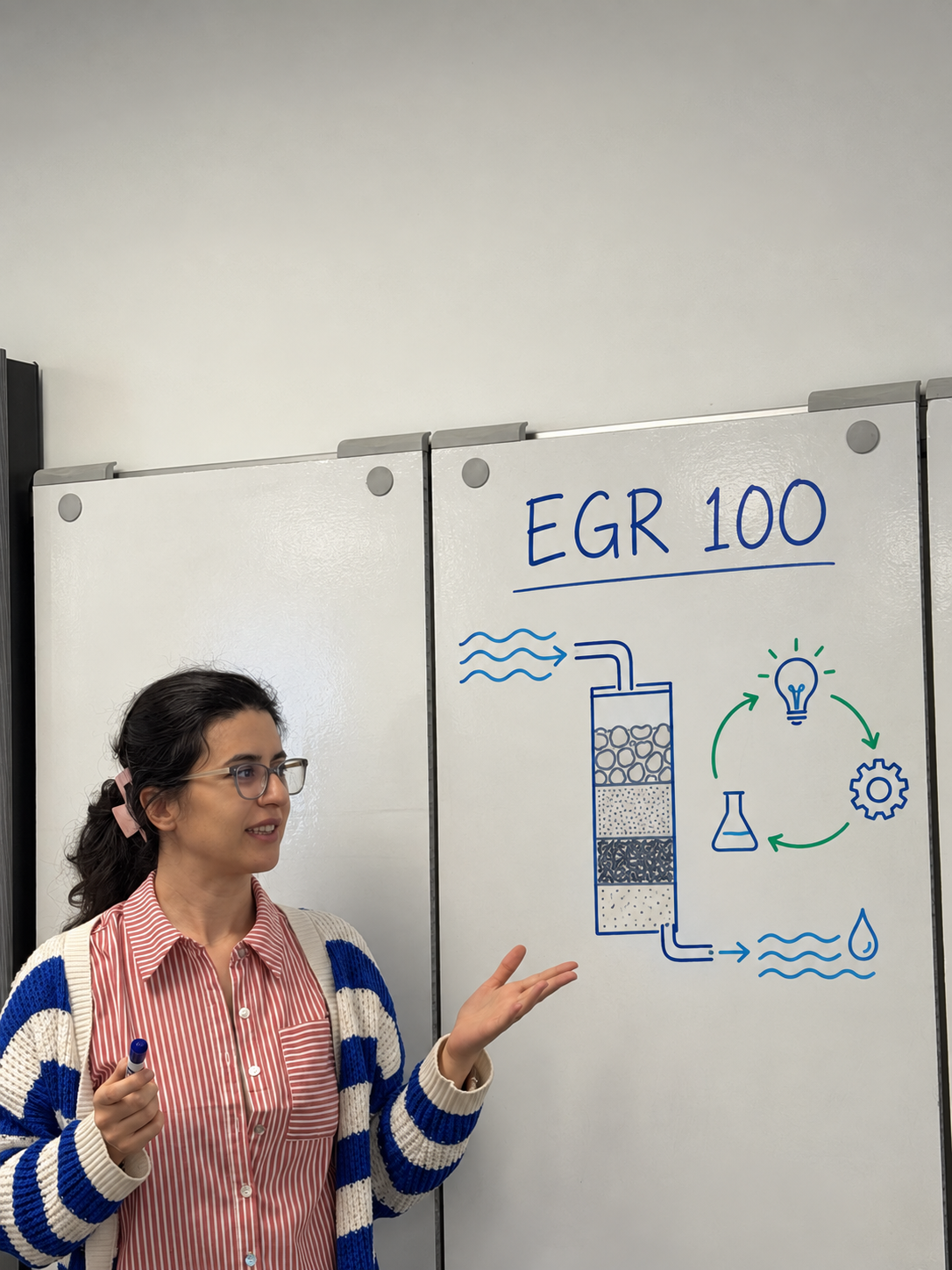
“I want students to leave my classroom able to do more than solve the problems I have taught them. I want them to know how to think when the problem is unfamiliar.”
My role is to help students become thoughtful engineers who can explain their reasoning, recognize the human consequences of technical choices, and continue learning when a problem does not resemble a textbook example. I connect environmental problems to the systems behind them: boundaries, inputs, outputs, accumulation, transport and transformation. Students build a conceptual model, select equations, state assumptions, check whether an answer is reasonable, and communicate what it means.
I use short explanations followed by opportunities to retrieve, apply, discuss and revise. Rather than complete an entire calculation while students watch, I model a first decision and ask students to carry the next step. As their understanding grows, I reduce the scaffolding and ask them to address less structured problems.
Inclusion is part of this design. I share criteria in writing, provide multiple ways to ask questions and contribute, rotate team responsibilities, and normalize evidence-based disagreement. I look for patterns in participation and student work, solicit feedback, and revise a teaching choice when it creates an unintended barrier.
Example learning activity · Whose Water, Which Solution?
In this designed activity, teams compare treatment options for a community facing water contamination. Students first form an individual recommendation, then examine performance, cost, maintenance, community priorities and uncertainty in assigned roles. They create a decision matrix, exchange feedback, revise their recommendation and explain individually which evidence changed their thinking.
02 / Certificate in College Teaching
Five teaching competencies
These reflections synthesize completed CIRTL and college-teaching development work. Each connects a principle to a concrete engineering-teaching decision.
I start with what students should be able to do, then align practice and assessment to that goal.
In environmental engineering, a mass balance begins with a model: define the system boundary, identify inputs, outputs, accumulation and reactions, state assumptions, then choose equations. I design learning objectives that move students beyond reproducing a procedure toward interpreting a system and defending a decision.
In my teaching: I use worked examples to show expert choices, then ask students to complete the next step, compare approaches, and solve progressively less structured problems.
High expectations require genuine ways for every student to participate and get support.
Students can think and write before speaking, compare with a partner, and contribute through structured team roles. I make assignment criteria and office-hour expectations explicit, use multiple ways to ask questions, and watch whose ideas shape the team’s final work.
In my teaching: In a designed water-treatment activity, students consider performance, cost, maintenance, community priorities and uncertainty without being asked to represent an identity group. Mistakes reveal a model to investigate, not a reason for embarrassment.
The learning objective comes first; the tool helps students see, test or evaluate something meaningful.
Spreadsheets, process diagrams and computational models can connect equations to physical systems and reveal the effects of changing assumptions. Students still need to justify inputs, test whether outputs are physically reasonable and explain the implications of a result.
In my teaching: Generative AI can assist a design process, but students remain responsible for verifying evidence and calculations, disclosing its use when required, and defending their own engineering judgment. My planned Spring 2027 teaching inquiry will study structured AI use in engineering learning.
I adapt strong teaching principles to the institution, course, students and resources in front of me.
Research and teaching strengthen each other when students work with authentic data, incomplete evidence and emerging questions. Access to research experiences should not depend on already knowing the unwritten rules of academic life.
In my teaching: The approach to a large first-year design lab differs from a small upper-level environmental engineering course. I adapt participation structures and support while preserving rigor and attention to student learning.
Assessment tells students what quality work looks like and tells me what needs to change in my teaching.
If a learning objective asks students to evaluate a solution, recalling terms is insufficient evidence. I use predictions, annotated diagrams, short explanations and team checkpoints to see reasoning early. Rubrics make criteria for conceptual models, technical accuracy, assumptions, evidence and communication transparent.
In my teaching: Individual preparation and reflection complement team products. Feedback and revision help students progress from knowing and applying toward analyzing, evaluating and creating.
I completed more than 30 approved learning sessions in evidence-based STEM teaching, active learning, inclusive learning environments, supporting students who fall behind, and strategies for creating connection in large courses.
My reflection on a transgender-inclusive STEM environment examined precise language, representation, curriculum content, and student privacy as elements of an ongoing inclusive-teaching practice.
Certificate in College Teaching · in progress
These five competencies and my teaching philosophy form part of my portfolio. My mentored teaching project is planned for Spring 2027; I will add its implementation, observations, evidence of student learning, and reflections after completion.
04 / Teaching experience
Courses and mentoring
Fall 2026 · EGR 100, Introduction to Engineering Design
Graduate Teaching Assistant, MSU. Three laboratory sections and two weekly open-lab hours; team-based design coaching, assignment guidance and formative feedback.
Fall 2024 · ENE 280, Principles of Environmental Engineering and Science
Graduate Teaching Assistant, MSU. Supported problem solving, student questions, assessment and course logistics.
Spring 2026 · ENE 487, Microbiology for Environmental Science and Engineering
Exam administration and consistent assessment support, MSU.
Earlier teaching and mentoring
Teaching Assistant in Hydrological Modeling at Amirkabir University of Technology (2019) and Differential Equations at the University of Tehran (2014–2016). ENSURE undergraduate research mentor at MSU (2023), teaching qPCR, GC-FID, experimental controls, data interpretation and lab safety.
05 / Next study
Responsible AI in engineering education
For a planned mentored teaching project with Mohsen Faghihinezhad and Alison M. Cupples, I want to examine structured uses of AI that support learning without displacing students’ own problem formulation, verification and engineering judgment. This is a planned study; methods and findings will be added after the project.
Mentorship & service
Helping emerging engineers build confidence and communicate sound decisions.
I mentor undergraduate researchers in laboratory methods, including qPCR, chromatography, and experimental troubleshooting. In the classroom I help student teams divide work, explain choices, and find a path forward when a first design does not work.
MentorshipUndergraduate research and first-year design teams
CommunicationTechnical presentations for broad audiences